
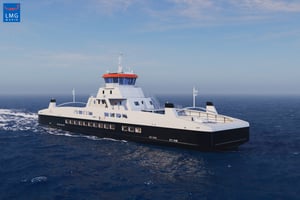
From 2027, Fjord1’s new battery-hybrid ferry Sognesjø is planned to connect four stops across the outer Sognefjord. NES is integrating the systems onboard and delivering charging infrastructure at Rysjedalsvika and Krakhella.
Named after the waters she will serve, Sognesjø is currently under construction at Tersan Shipyard. The 74-metre double-ended ferry, designed by LMG Marin, will have capacity for 60 cars and 199 passengers.
A vital link across the outer Sognefjord
The route crosses Sognesjøen at the western end of Norway’s longest fjord, connecting communities in Hyllestad, Gulen and Solund.
Rysjedalsvika and Rutledal link the ferry service to the mainland road network. On the other side, Krakhella serves as Solund’s main road connection to the mainland, while Losna has its own ferry call.
For an island municipality such as Solund, the ferry is an essential part of the transport network. The municipality has 742 residents, but the route carries considerably more traffic than the population figure might suggest. More than 181,000 passengers and 61,000 vehicles travelled on the connection in 2025.
Fjord1 will operate the route under the ferry contract commissioned by Skyss on behalf of Vestland County Council.
A battery-hybrid power system
At the heart of Sognesjø will be an approximately 6 MWh battery system. The vessel will also be able to receive charging power of up to 8.8 MW from shore at Rysjedalsvika.
The ferry is designed for hybrid operation. Battery power and shore charging will play a central role, while onboard generators remain part of the power system.
NES is the system integrator for the vessel, with responsibility for bringing the different systems together. The delivery includes the battery system, electric propulsion, generators, transformers, AC and DC switchboards, integrated automation, and navigation and communication equipment.
The individual components come with different functions, requirements and interfaces. Our job is to make sure they operate as one complete system throughout the vessel.
From shore to vessel
NES’ involvement also extends beyond the ferry itself.
Under a separate contract with Fjord1, we are supplying the charging infrastructure at Rysjedalsvika and Krakhella. This means that NES is involved on both sides of the connection: in the infrastructure delivering energy from shore and in the systems receiving, distributing and managing it onboard.
The contract for the onboard systems was announced in September 2025, when Tersan Shipyard selected NES as system integrator. At that time, neither the shipowner nor the operating route was disclosed.
The separate contract for the two shore-charging stations was announced in January 2026.
With the shipowner, route and vessel name now confirmed, the full context of the two deliveries is clear. When Sognesjø enters service, NES systems will be at work both onboard the ferry and ashore at the charging locations.